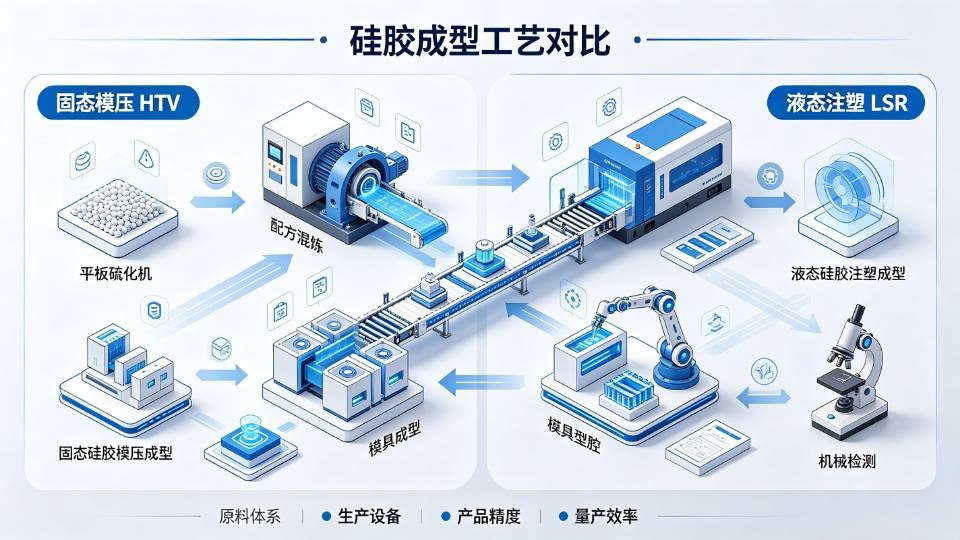
在现代硅胶制造产业链中,成型工艺是决定产品品质、精度、适用场景及量产成本的核心核心环节,其中固态硅胶模压成型与液态硅胶注塑成型是目前行业占有率最高、应用最广泛的两大主流工艺。绝大多数采购方、行业新人乃至普通消费者,仅知晓硅胶制品的基础特性,却无法清晰区分两种工艺的本质差异。事实上,二者在原料体系、生产设备、加工流程、产品精度、性能表现及量产适配性上有着天壤之别,也是行业产品分级、价格差距、市场分层的核心原因。深入了解两种工艺的核心区别,是读懂硅胶制造行业的基础。
In the modern silicone manufacturing industry chain, molding processes are the core link that determines product quality, precision, applicable scenarios, and mass production costs. Among them, solid silicone compression molding and liquid silicone injection molding are currently the two mainstream processes with the highest industry market share and the widest application. The vast majority of buyers, newcomers to the industry, and even ordinary consumers are only aware of the basic characteristics of silicone products, yet cannot clearly distinguish the essential differences between the two processes. In fact, they differ greatly in material systems, production equipment, processing procedures, product precision, performance, and mass production adaptability, which are also the core reasons for product grading, price differences, and market segmentation within the industry. A thorough understanding of the fundamental differences between these two processes is the basis for comprehending the silicone manufacturing industry.
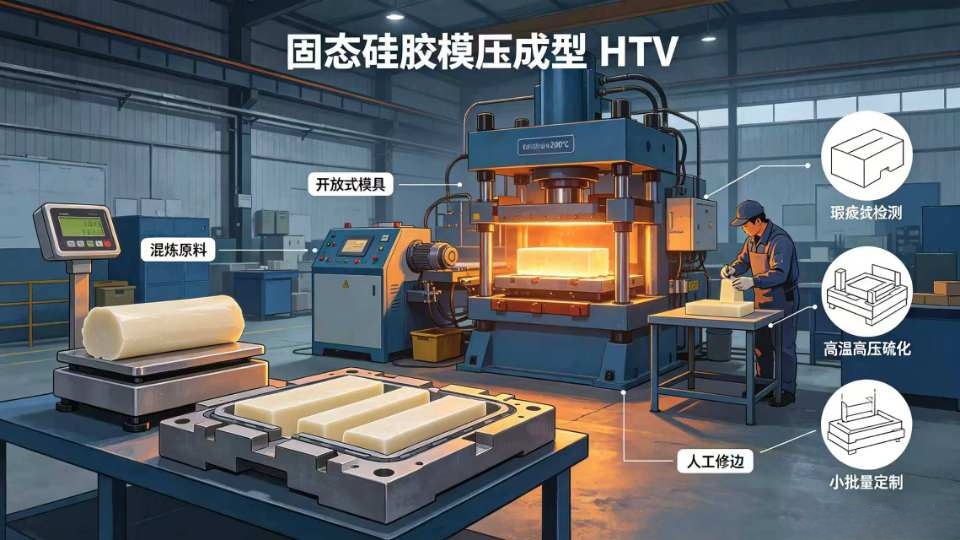
固态硅胶模压成型,学名高温硫化硅胶成型(HTV),是硅胶行业发展数十年的传统经典工艺,凭借技术成熟、投入成本低、适配性广的优势,至今仍是中小制造企业的主力生产工艺。该工艺的核心原料为固态混炼硅橡胶,生产前期需要专业设备将生胶、硫化剂、色母、补强填料、抗老化助剂等多种辅料,按照固定配方比例充分混炼均匀,压制成片状、块状备用原料,整套原料预处理工序繁琐,依赖人工与设备配合。正式生产时,工作人员需根据产品规格裁切、精准称重原料,放入定制的开放式模具型腔中,利用平板硫化机提供160℃-200℃的高温与高压环境,让硅胶原料在密闭压力下完成硫化交联反应,待材质完全固化定型后,完成脱模、人工修边、瑕疵检测、二次修整等工序,最终得到成品。
Solid silicone molding, scientifically known as high-temperature vulcanized silicone molding (HTV), is a classic traditional process that has been developed in the silicone industry over several decades. Due to its advantages of mature technology, low investment cost, and wide adaptability, it remains the main production process for small and medium-sized manufacturing enterprises. The core raw material of this process is solid compounded silicone rubber. In the early stages of production, specialized equipment is required to thoroughly mix the raw silicone rubber with various auxiliary materials such as vulcanizing agents, color masterbatches, reinforcing fillers, and anti-aging additives according to a fixed formula ratio. The mixture is then compressed into sheets or blocks as raw materials for later use. The entire raw material pre-processing procedure is cumbersome and relies on both manual labor and equipment coordination. During actual production, workers need to cut and accurately weigh the raw materials according to product specifications, place them into custom open mold cavities, and use a flat vulcanizing press to provide a high-temperature and high-pressure environment of 160°C to 200°C, allowing the silicone material to complete the vulcanization and cross-linking reaction under sealed pressure. Once the material is fully cured and formed, the process is followed by demolding, manual trimming, defect inspection, and secondary finishing, ultimately resulting in the finished product.
固态模压工艺的核心优势十分鲜明,首先是设备与模具门槛极低,普通碳钢模具即可满足生产需求,模具造价低廉、加工周期短、修改便捷,适配新品打样、小批量定制场景。其次工艺容错率高,可生产厚度跨度大、结构简单的实心、空心硅胶制品,整体生产稳定性强,极少出现批量报废问题。但其短板也尤为突出,自动化程度偏低,核心工序依赖人工操作,生产周期较长,单模单次成型耗时普遍在30秒-3分钟,量产效率有限。同时受开放式模具结构限制,产品合模处会产生明显合模线,需要人工二次修边,无法实现微米级精密成型,难以适配超薄、异形、高精度的复杂结构产品。目前该工艺主要用于生产硅胶密封圈、防滑脚垫、普通硅胶套管、日用硅胶小件等性价比导向的常规产品。
The core advantages of the solid-state molding process are quite distinct. Firstly, the threshold for equipment and molds is very low; ordinary carbon steel molds can meet production requirements. Mold costs are inexpensive, processing cycles are short, modifications are convenient, making it suitable for prototyping new products and small-batch customization scenarios. Secondly, the process has a high tolerance for errors, capable of producing solid and hollow silicone products with a wide range of thicknesses and simple structures. Overall production stability is strong, and batch wastage issues are rare. However, its shortcomings are also particularly pronounced. The level of automation is relatively low, key processes rely on manual operations, production cycles are long, and single-mold single-time forming generally takes 30 seconds to 3 minutes, limiting mass production efficiency. Additionally, due to the constraints of open mold structures, products tend to have obvious parting lines that require manual secondary trimming, making micron-level precision molding unattainable and challenging for ultra-thin, irregular, or high-precision complex structures. Currently, this process is mainly used for producing cost-effective conventional products such as silicone sealing rings, anti-slip mats, ordinary silicone sleeves, and small daily-use silicone items.
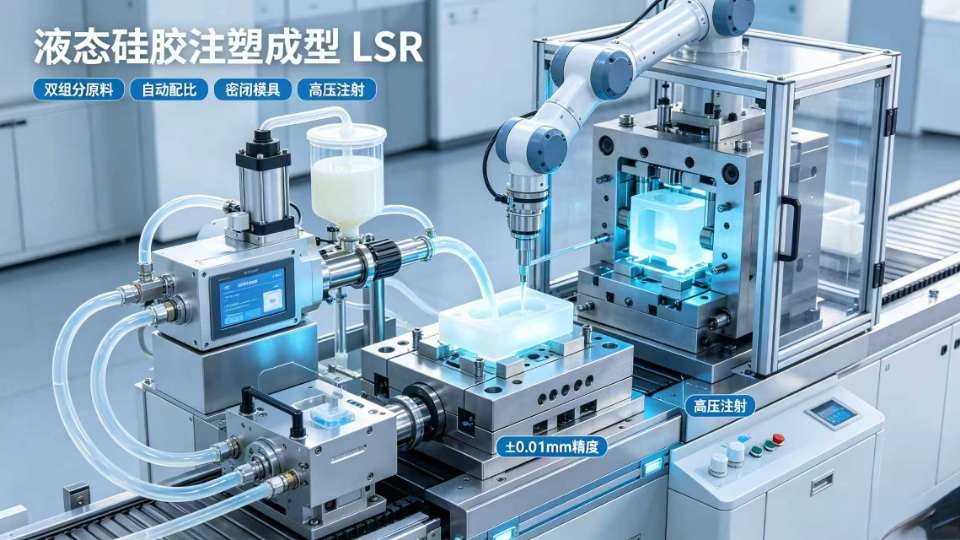
液态硅胶注塑成型(LSR)是现代高端硅胶制造的核心工艺,也是行业技术升级的核心方向,完美弥补了固态模压工艺的短板。该工艺采用双组分液态硅橡胶为核心原料,A、B两组分原料自带配比体系,无需提前人工混炼,原料本身流动性极强、纯度极高、杂质含量极低,从原料端就奠定了高品质基础。生产环节采用专用液态硅胶精密注塑机,设备搭载智能配比泵体、高压注射系统、恒温密闭模具,可自动完成原料精准配比、高压注射、型腔填充、高温固化、自动脱模全流程工序,全程无需人工干预,实现全自动化闭环生产。固化温度精准可控,成型速度极快,单款产品成型周期可压缩至10-30秒,量产效率是传统模压工艺的3-5倍。
Liquid silicone rubber injection molding (LSR) is the core process in modern high-end silicone manufacturing and a key direction for industry technology upgrades. It perfectly addresses the shortcomings of solid molding processes. This process uses two-component liquid silicone rubber as the main material, with the A and B components already having a set ratio, so there’s no need for manual pre-mixing. The material itself is highly fluid, extremely pure, and contains very few impurities, laying a solid foundation for high quality right from the start. In production, specialized LSR precision injection machines are used, equipped with smart ratio pumps, high-pressure injection systems, and temperature-controlled sealed molds. These machines can automatically handle precise material mixing, high-pressure injection, cavity filling, high-temperature curing, and automatic demolding, performing the whole process without any human intervention and achieving fully automated closed-loop production. The curing temperature is accurately controllable, and the molding speed is extremely fast, with a single product cycle compressed to 10-30 seconds, making mass production 3-5 times more efficient than traditional molding processes.
在产品品质与精度层面,液态硅胶注塑工艺优势显著。密闭精密模具无开放式合模缝隙,产品整体无合模线、无明显毛边,几乎无需人工修边,大幅降低人工成本与产品损耗。其尺寸成型精度可稳定控制在±0.01mm,能够轻松完成0.1mm超薄硅胶薄膜、异形曲面、复杂镂空、精密密封结构等高端产品的成型生产,这是固态模压工艺无法实现的技术突破。同时液态硅胶原料硫化更充分、分子结构更稳定,产品密封性、平整度、均匀度远超固态硅胶制品,且材质纯净无杂质,无异味、不析出有害物质。
In terms of product quality and precision, liquid silicone injection molding technology offers significant advantages. The sealed precision molds have no open parting line gaps, resulting in products with no mold lines or obvious flash, requiring almost no manual trimming, thereby greatly reducing labor costs and product waste. The dimensional molding accuracy can be consistently controlled within ±0.01mm, easily achieving the production of high-end products such as 0.1mm ultra-thin silicone films, irregular curved surfaces, complex hollowed-out designs, and precise sealing structures—technical breakthroughs that cannot be achieved with solid silicone molding processes. Moreover, the vulcanization of liquid silicone raw materials is more complete, with a more stable molecular structure, resulting in products with sealing performance, flatness, and uniformity far superior to solid silicone products, while the material remains pure, free of impurities, odorless, and non-toxic.
两种工艺的性能差异,直接划分了行业的应用场景与市场层级。固态硅胶制品韧性优异、耐磨抗撕、性价比极高,适配工业通用密封、机械缓冲、普通日用制品、户外防护等对精度、纯度要求不高的场景,占据中低端硅胶制品主流市场。液态硅胶制品纯度高、生物相容性好、耐高温稳定性强、密封精度顶尖,可完全满足FDA食品级、欧盟LFGB、ISO13485医疗级认证标准,广泛应用于母婴奶嘴、食品厨具配件、医用导管、精密电子防水配件、新能源汽车密封件等高端领域。
The performance differences between the two manufacturing processes directly determine their industry application scenarios and market tiers. Solid silicone products have excellent toughness, wear and tear resistance, high cost-effectiveness, and are suitable for industrial general sealing, mechanical cushioning, ordinary daily-use products, outdoor protection, and other scenarios where precision and purity requirements are not high, occupying the mainstream market for mid-to-low-end silicone products. Liquid silicone products, on the other hand, feature high purity, good biocompatibility, strong high-temperature stability, and top-notch sealing precision, fully meeting FDA food-grade, EU LFGB, and ISO13485 medical-grade certification standards. They are widely used in high-end fields such as baby pacifiers, food kitchenware accessories, medical catheters, precision electronic waterproof components, and sealing parts for new energy vehicles.
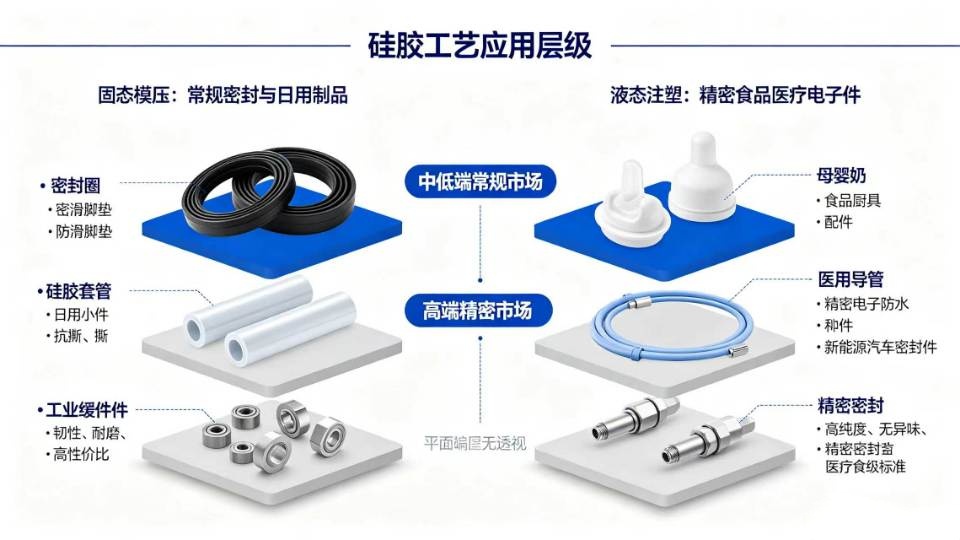
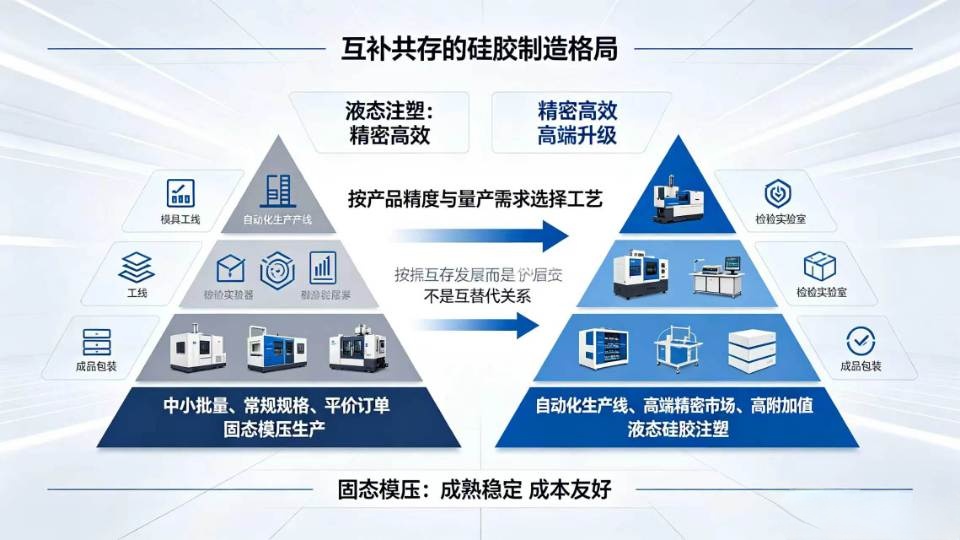
从行业发展格局来看,两种工艺并非新旧替代关系,而是互补共存、分层适配的行业格局。国内中小硅胶制造企业大多依托固态模压工艺,承接中小批量、常规规格的平价订单;头部规模化企业则全面布局液态硅胶自动化注塑生产线,深耕高端精密市场,获取更高产品附加值。对于行业从业者、采购人员而言,精准区分两种成型工艺的优劣与适配场景,能够有效优化产品选型、控制生产成本、提升产品品质,是深耕硅胶制造行业不可或缺的专业基础。
From the perspective of industry development patterns, the two processes are not in a new-versus-old replacement relationship, but rather exist complementarily, with layered adaptation within the industry. Most small and medium-sized silicone manufacturers in China rely on solid molding processes to handle small to medium batch orders of conventional specifications at affordable prices; leading large-scale enterprises, on the other hand, have comprehensively deployed automated liquid silicone injection production lines, focusing on the high-end precision market to obtain higher product added value. For industry practitioners and procurement personnel, accurately distinguishing the advantages and suitable application scenarios of the two molding processes can effectively optimize product selection, control production costs, and improve product quality, serving as an indispensable professional foundation for deeply engaging in the silicone manufacturing industry.