在硅胶制品的生产中,硫化过程是那个化腐朽为神奇的分水岭。在这之前,混炼胶像一个听话的孩子,你可以随意把它捏成任何形状;而一旦经过硫化,它就拥有了固定的形状和“记忆”,无论怎么拉扯,都能迅速弹回原样。这究竟是怎么发生的?
In the production of silicone products, the vulcanization process marks the critical turning point that transforms the material from mundane to extraordinary. Before this process, the compounded silicone behaves like an obedient child, allowing you to shape it freely into any form; however, once vulcanized, it acquires a fixed shape and ‘memory,’ capable of quickly returning to its original form no matter how it is stretched. How exactly does this happen?

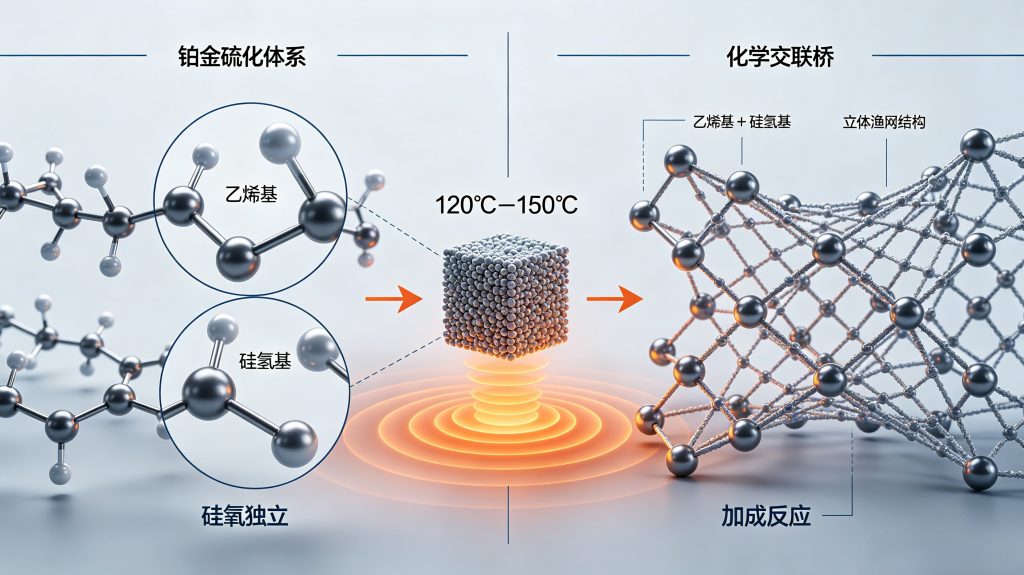
从微观角度看,硫化过程其实是一场分子层面的“手拉手”运动。以最常见的铂金硫化体系为例,在加热到120℃至150℃时,混炼胶中的乙烯基和硅氢基在铂金催化剂的撮合下,瞬间发生加成反应,原本线性独立的硅氧烷分子链之间架起了密密麻麻的化学交联桥。这就像把一盘散沙突然变成了一张严密的立体渔网。这张网的密度,直接决定了硅胶产品的硬度、抗撕裂强度和回弹率。
From a microscopic perspective, the vulcanization process is essentially a ‘hand-in-hand’ movement at the molecular level. Taking the most common platinum-catalyzed vulcanization system as an example, when heated to 120°C to 150°C, the vinyl and silane groups in the compounded rubber undergo an instantaneous addition reaction under the orchestration of the platinum catalyst, forming dense chemical crosslinking bridges between originally linear and independent siloxane chains. It is like suddenly turning a pile of loose sand into a tightly woven three-dimensional fishing net. The density of this network directly determines the hardness, tear resistance, and elasticity of the silicone product.
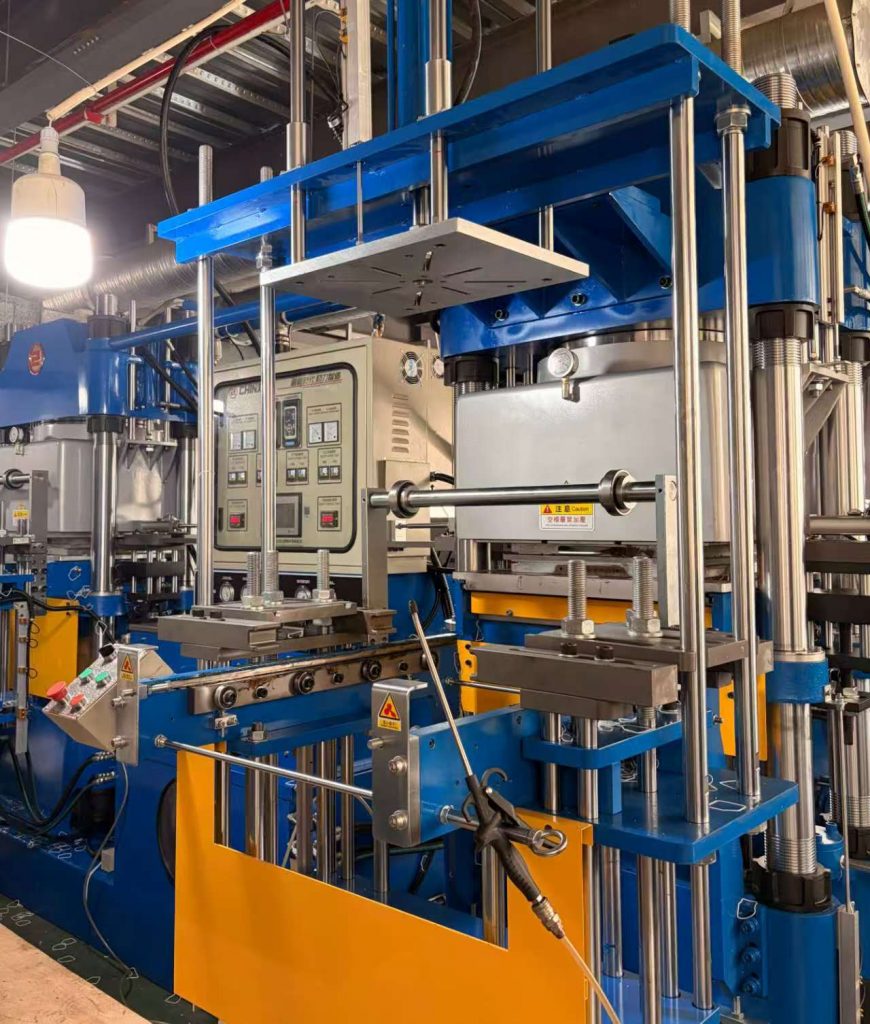
要驾驭好硫化过程并不容易。时间、温度和压力,这三个参数必须像交响乐一样精准配合。如果硫化时间太短,交联密度不够,产品就会发软发粘,这就是我们常说的“欠硫”;如果温度太高或者时间过长,分子链则会过度交联甚至断裂降解,导致“过硫”,硅胶变得又脆又硬,毫无弹性可言。对于那些结构复杂的大型硅胶密封件,硫化时还需要分段升温,并施加巨大的锁模压力,才能排尽模具中的气体,防止产生致命的气泡。
Mastering the vulcanization process is not easy. Time, temperature, and pressure—these three parameters must be coordinated with precision like a symphony. If the vulcanization time is too short, the crosslinking density will be insufficient, causing the product to be soft and sticky, which is what we commonly refer to as ‘under-vulcanization.’ Conversely, if the temperature is too high or the time too long, the molecular chains may become excessively crosslinked or even break down, resulting in ‘over-vulcanization,’ where the silicone becomes brittle and hard, completely lacking elasticity. For large silicone seals with complex structures, it is also necessary to increase the temperature in stages and apply substantial mold-clamping pressure during vulcanization to expel air from the mold and prevent the formation of critical bubbles.
更讲究的是,不少硅胶件脱模后还会被送入烘箱进行二段硫化。这可不是为了把它烤得更熟,而是为了彻底抽走一段硫化后残留的低分子挥发性物质,进一步提升物理性能。经过这场高温洗礼,硅胶才算真正脱胎换骨,成为那件既柔软又强韧的完美之作。
What is more sophisticated is that many silicone parts, after demolding, are sent into an oven for a secondary vulcanization. This is not to make them more ‘cooked,’ but to thoroughly remove the low-molecular volatile substances remaining after the first-stage vulcanization, thereby further enhancing their physical properties. After undergoing this high-temperature treatment, the silicone can truly be said to be reborn, transforming into a perfect work that is both soft and strong.