
在硅胶工厂里流传着一句老话:“垃圾进,垃圾出。”无论你的硫化过程控制得多么完美,模具雕得多么精致,如果买回来的原料——那块生胶——本身就先天不足,所有的努力都是白费。原料控制,是所有高品质硅胶产品诞生的绝对起点。
There is an old saying in silicone factories: ‘Garbage in, garbage out.’ No matter how perfectly you control the vulcanization process or how exquisitely the molds are carved, if the raw material you purchase—the raw rubber—is inherently flawed, all your efforts will be in vain. Material control is the absolute starting point for the production of all high-quality silicone products.
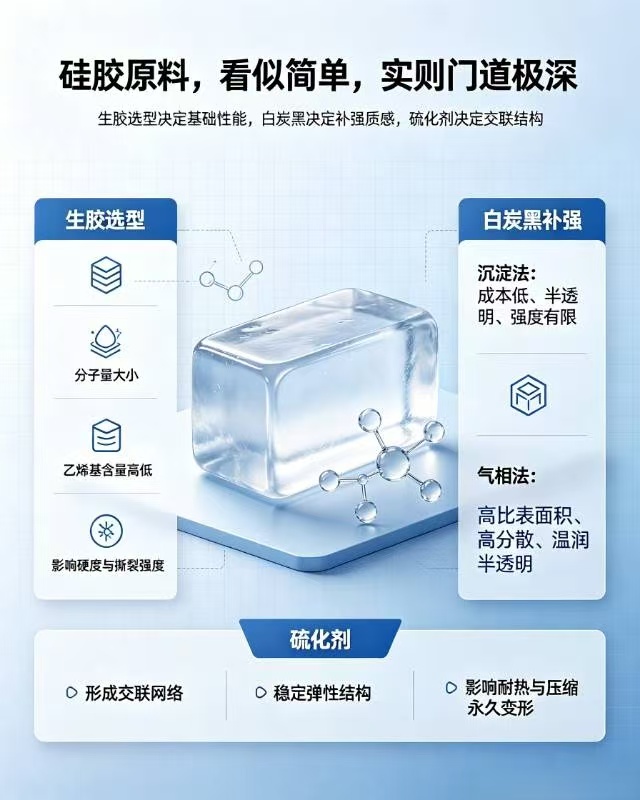
硅胶的原料听起来简单,无非是生胶、白炭黑和硫化剂,但里面的门道极深。首先是生胶的选型,其分子量大小、乙烯基含量高低,直接决定了成品的基础硬度和撕裂强度。做高透高抗撕的奶嘴,和做普通工业垫片,需要选用的生胶牌号截然不同。其次,补强填料白炭黑的分毫之差,影响更是天翻地覆。沉淀法白炭黑成本低,但做出的硅胶半透明、强度差;只有比表面积足够大、分散性极高的气相法白炭黑,才能赋予硅胶制品那种特有的半透明温润质感和优异的物理机械性能。
The raw materials of silicone may sound simple, consisting merely of natural rubber, precipitated silica, and vulcanizing agents, but there is a profound complexity to them. First is the selection of natural rubber, where the molecular weight and vinyl content directly determine the base hardness and tear strength of the final product. The type of natural rubber used for making high-transparency, tear-resistant baby nipples is entirely different from that needed for ordinary industrial gaskets. Second, even the slightest difference in the reinforcing filler, precipitated silica, can make a world of difference. Precipitated silica produced by the precipitation method is low-cost but results in silicone that is semi-transparent with poor strength. Only fumed silica, with a sufficiently large specific surface area and excellent dispersibility, can endow silicone products with their unique semi-transparent, smooth texture and superior physical and mechanical properties.
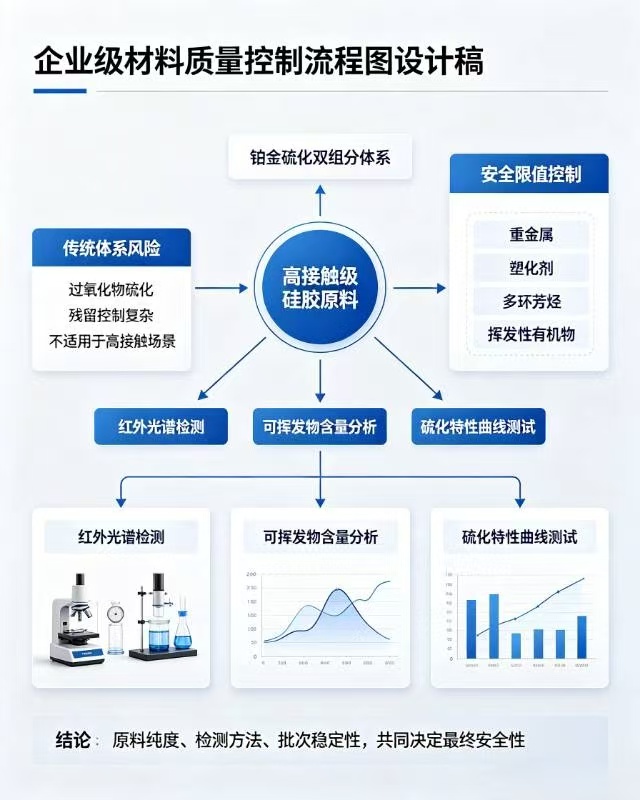
在食品与医疗领域,原料控制更是不能触碰的红线。严格来说,用于婴儿护理或人体植入的硅胶,必须摒弃传统的过氧化物硫化体系,转而使用纯度极高的铂金硫化双组分原料。这种原料对于重金属含量、塑化剂以及多环芳烃的要求近乎苛刻。任何一批进厂的原料,都需要在实验室里接受红外光谱检测、可挥发物含量分析以及硫化特性曲线测试,确保每一批次原料的稳定性。
In the food and medical fields, raw material control is an untouchable red line. Strictly speaking, silicone used for infant care or human implantation must abandon the traditional peroxide vulcanization system and instead utilize two-component platinum-cured materials of extremely high purity. Such materials have almost stringent requirements regarding heavy metal content, plasticizers, and polycyclic aromatic hydrocarbons. Every batch of incoming raw materials must undergo infrared spectroscopy testing, volatile content analysis, and vulcanization characteristic curve testing in the laboratory to ensure the stability of each batch of materials.
我们常说细节决定成败,对于硅胶产品来说,这个细节早在生胶出厂的那一刻就开始了。消费者也许摸不出乙烯基含量的高低,但用起来起不起白霜、容不容易撕裂,这些直观感受背后,全是原料控制这一只看不见的手在运筹帷幄。只有从源头锁死品质,后面的炼胶过程才有意义。
We often say that success or failure is determined by details. For silicone products, this attention to detail begins the moment the raw silicone leaves the factory. Consumers may not be able to discern the vinyl content, but whether the product turns white with use or tears easily—these intuitive experiences are all orchestrated by the invisible hand of raw material control. Only by securing quality from the source does the subsequent compounding process become meaningful.