
在云南西双版纳勐腊县的万亩热带雨林中,绵延百万亩的橡胶林错落生长,这片我国核心的天然橡胶产区,承载着特殊的生态价值、民生价值与国家战略价值。作为全国橡胶种植第一县,勐腊县橡胶种植面积超230万亩,占全国种植总面积的13%,是国内规模最大、品质最优的天然橡胶供给基地之一,更是支撑我国工业、国防、民生领域发展的重要战略资源腹地。
In the ten-thousand-acre tropical rainforest of Mengla County, Xishuangbanna, Yunnan, vast rubber plantations stretch over millions of acres in a staggered pattern. This core natural rubber production area in China carries special ecological, livelihood, and national strategic values. As the county with the largest rubber planting area in the country, Mengla County has more than 2.3 million acres of rubber plantations, accounting for 13% of the total planting area nationwide. It is one of the largest and highest-quality natural rubber supply bases in China and serves as an important strategic resource hinterland supporting the development of China’s industry, national defense, and people’s livelihood.
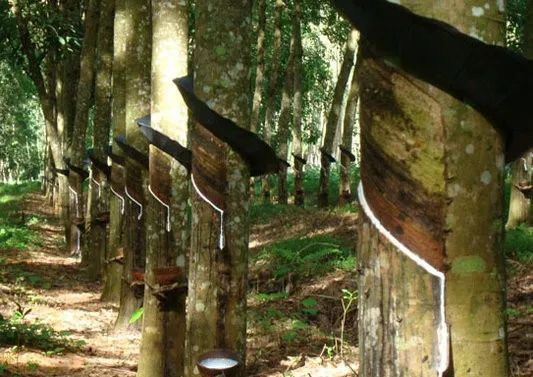
天然橡胶被誉为“工业软黄金”,凭借优异的弹性、绝缘性、耐磨性和可塑性,是现代工业无法替代的基础原材料。小到日常所见的轮胎、鞋底、乳胶制品,大到高端机械装备、国防军工配套部件,均离不开天然橡胶的支撑,是维系国民经济平稳运行的关键战略物资。而每一份优质天然橡胶的诞生,都始于雨林深处胶农的精细化采收,历经多道标准化工艺淬炼而成。
Natural rubber is known as the ‘soft gold of industry.’ With its excellent elasticity, insulation, wear resistance, and plasticity, it is an indispensable basic raw material in modern industry. From everyday items like tires, shoe soles, and latex products to high-end mechanical equipment and defense industry components, all depend on the support of natural rubber, making it a key strategic material for maintaining the stable operation of the national economy. The birth of every high-quality natural rubber begins with the meticulous harvesting by rubber farmers deep in the rainforest and is refined through multiple standardized processes.
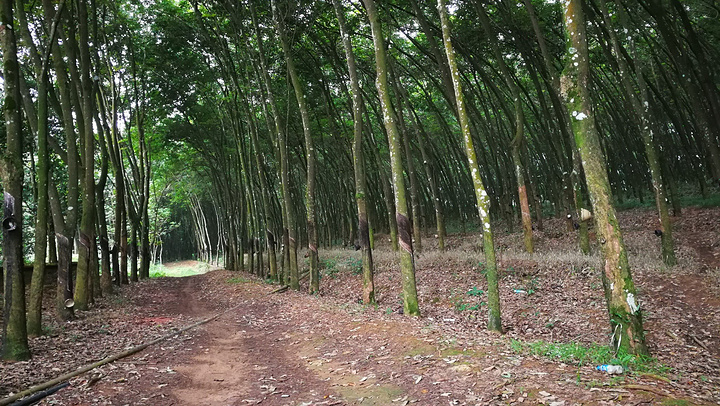
一、雨林采收:顺应自然的匠心劳作Rainforest Harvesting: Artisan Work in Harmony with Nature
勐腊属北热带湿润季风气候,光热、降水条件适配橡胶树生长习性,孕育出的乳胶质地纯净、胶质优良。橡胶树的采收极具时效性与专业性,受雨林闷热潮湿的特殊环境影响,乳胶的物理状态变化极快,对采收时机、操作工艺有着严苛要求。
Mengla belongs to the northern tropical humid monsoon climate. The light, heat, and precipitation conditions are well suited to the growth habits of rubber trees, resulting in latex that is pure in texture and of excellent quality. The harvesting of rubber trees is highly time-sensitive and specialized. Affected by the hot and humid conditions of the rainforest, the physical state of the latex changes very quickly, demanding strict requirements for the timing of harvesting and operational techniques.
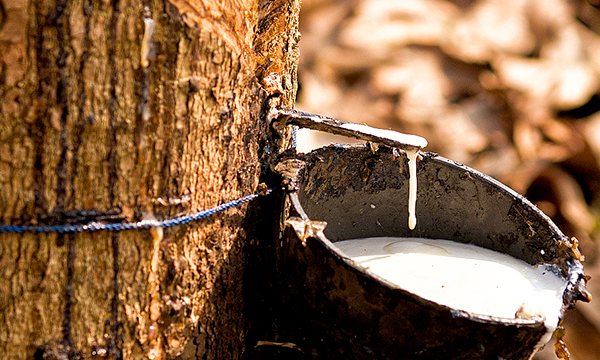
橡胶树经多日停割后,树皮切口处残留的乳胶会自然氧化、凝固,在收集碗内形成厚实胶膜,这也是橡胶天然凝固特性的直观体现。专业胶农会遵循标准化割胶工艺,在橡胶树皮层精准划开纹路适度的切口,树皮内的乳管被有序切开,乳白色的新鲜乳胶便会匀速渗出、缓缓滴落。
After several days of not tapping, the latex remaining at the cuts on the rubber tree bark naturally oxidizes and coagulates, forming a thick latex film in the collection cup. This is also a direct manifestation of the natural coagulating characteristic of rubber. Professional latex farmers follow standardized tapping techniques, making precise, appropriately sized incisions on the bark layers of rubber trees. The latex vessels inside the bark are cut in an orderly manner, allowing the milky fresh latex to seep out evenly and drip slowly.
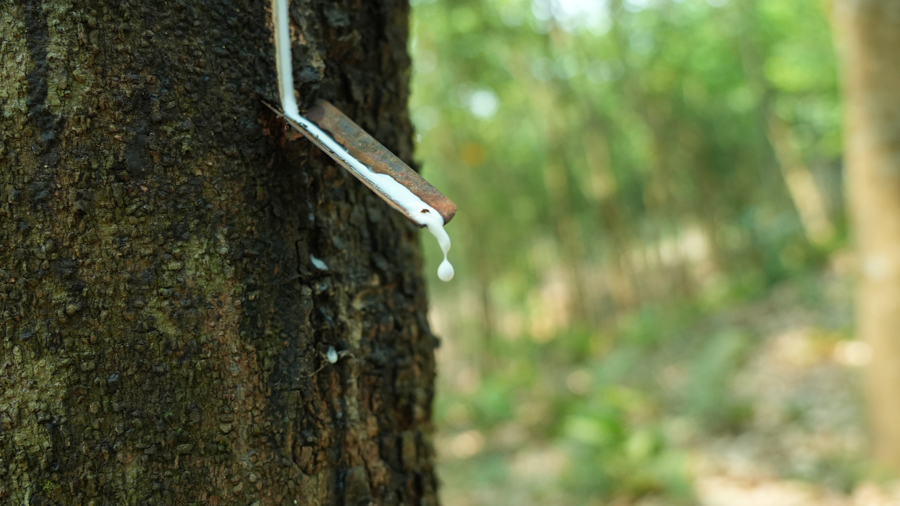
新鲜乳胶的采收是一场与时间的赛跑。雨林高温高湿的环境下,暴露在空气中的乳胶会快速凝固老化,若未能及时收集,鲜乳胶会转化为胶质、韧性、品相均大幅下降的二级橡胶原料,经济价值与应用层级大打折扣。只有及时采收的纯净鲜乳胶,才能作为一级天然橡胶的核心原料,适配高端工业生产需求。
The harvesting of fresh latex is a race against time. In the hot and humid environment of the rainforest, latex exposed to the air will quickly coagulate and age. If not collected promptly, fresh latex will turn into secondary rubber raw material with significantly reduced gel content, toughness, and appearance, greatly diminishing its economic value and application level. Only freshly harvested, pure latex can serve as the core raw material for premium natural rubber, suitable for high-end industrial production needs.
雨林采收劳作条件严苛,林间蚊虫繁多、地势起伏错落,胶农需要背负胶桶在山林间穿梭数小时,往返爬坡下坡,全程高强度作业。一桶标准乳胶净重可达35公斤,当地胶农凭借常年劳作积累的经验与体力,单人可承载双桶乳胶运输,日均稳定采收量,为后续橡胶加工提供了充足优质原料,每一份乳胶都凝聚着基层劳动者的坚守与汗水。
The working conditions for rainforest harvesting are harsh, with abundant mosquitoes in the forest and uneven terrain. Rubber farmers need to carry latex buckets while trekking through the mountains for several hours, going up and down slopes, performing high-intensity work throughout. A standard bucket of latex can weigh up to 35 kilograms. Local rubber farmers, relying on the experience and physical strength accumulated over years of labor, can carry two buckets of latex by themselves. Their stable daily harvesting provides sufficient high-quality raw materials for subsequent rubber processing. Every bit of latex embodies the dedication and sweat of grassroots laborers.
二、源头质检:把控原料核心品质Source quality inspection: controlling the core quality of raw materials
为保障天然橡胶品质标准化,勐腊产区构建了完善的基层收购与质检体系,雨林全域每隔数公里便设置标准化橡胶收购站,搭建起“田间到厂区”的高效中转链路。
鲜乳胶送至收购站后,需经过含水率检测、称重计量、杂质过滤三道基础质检工序,其中含水率是判定乳胶品质的核心指标。乳胶含水率越高,干胶有效成分占比越低,原料品质与市场定价越低;低含水率、高纯净度的鲜乳胶,是生产高端一级橡胶的核心标准。完成质检与称重后,合格鲜乳胶会经过初步过滤净化,去除林间混入的杂质,再通过专用密封运输车恒温转运至橡胶加工厂,最大程度保留原料活性与品质。
To ensure standardized quality of natural rubber, the Mengla production area has established a comprehensive grassroots purchasing and quality inspection system. Standardized rubber purchasing stations are set up every few kilometers throughout the rainforest, creating an efficient transfer chain from ‘field to factory.’
After fresh latex is delivered to the purchasing station, it must go through three basic quality inspection procedures: moisture content testing, weighing, and impurity filtering, with moisture content being the key indicator for judging latex quality. The higher the moisture content in the latex, the lower the proportion of effective dry rubber, and the lower the quality of the raw material and its market price. Fresh latex with low moisture content and high purity is the core standard for producing high-end Grade A rubber. After completing quality inspection and weighing, qualified fresh latex undergoes preliminary filtering to remove impurities mixed in from the forest, and is then transported at a constant temperature in specialized sealed vehicles to the rubber processing factory, maximizing the retention of the raw material’s activity and quality.
三、工厂淬炼:液态乳胶到固态橡胶的蜕变Factory Quenching: The Transformation from Liquid Latex to Solid Rubber
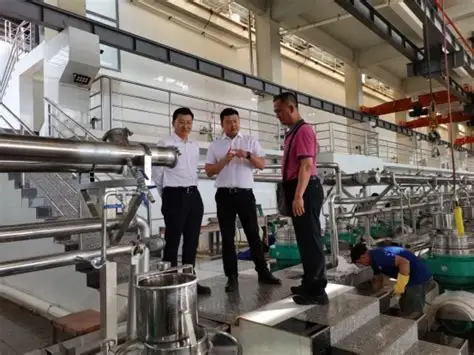
新鲜乳胶进入加工厂后,将通过标准化工业流程完成形态蜕变,全程工艺科学可控,精准保障橡胶成品品质。进厂的鲜乳胶自带天然清香,近似椰奶风味,是优质天然原料的直观特征。
After fresh latex enters the processing factory, it will undergo a morphological transformation through standardized industrial processes. The entire process is scientifically controlled to precisely ensure the quality of the rubber products. The fresh latex entering the factory carries a natural fragrance, resembling the flavor of coconut milk, which is an intuitive characteristic of high-quality natural raw materials.
加工首步为催化凝固:工作人员将纯净乳胶导入大型搅拌罐,精准配比加入草酸作为催化剂,通过匀速均匀搅拌,让药剂与乳胶充分融合,打破乳胶胶体平衡,加速液态乳胶固化。混合后的乳胶流入专用凝固槽,全程保持匀速搅拌,避免凝固不均、胶质分层,整套凝固流程耗时约20小时。
The first step of processing is catalytic coagulation: workers pour purified latex into a large mixing tank, add oxalic acid as a catalyst in precise proportions, and stir evenly at a constant speed to fully blend the reagents with the latex, breaking the latex colloidal balance and accelerating the solidification of liquid latex. The mixed latex then flows into a dedicated coagulation trough, with constant stirring maintained throughout to prevent uneven coagulation and separation of the gel. The entire coagulation process takes about 20 hours.
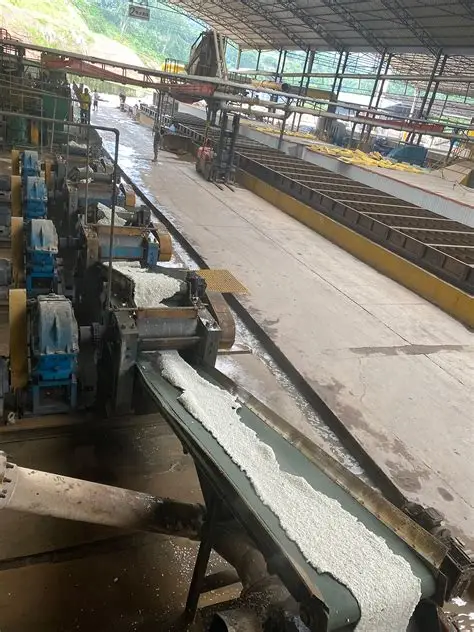
充分凝固后,液态乳胶会转化为质地细腻、色泽纯白的固态橡胶胶体,形态酷似豆腐块,这也是一级天然橡胶的半成品雏形。为防止胶体粘连池底、影响后续加工,工人会进行人工脱池作业,通过脚感精准分离胶体与池体,最大程度保护胶体完整度与内部结构稳定性。
After fully solidifying, the liquid latex will transform into a solid rubber colloid with a delicate texture and pure white color, resembling a block of tofu. This is also the semi-finished prototype of first-grade natural rubber. To prevent the colloid from sticking to the bottom of the vat and affecting subsequent processing, workers perform manual removal from the vat, precisely separating the colloid from the vat by feel, maximizing the protection of the colloid’s integrity and the stability of its internal structure.
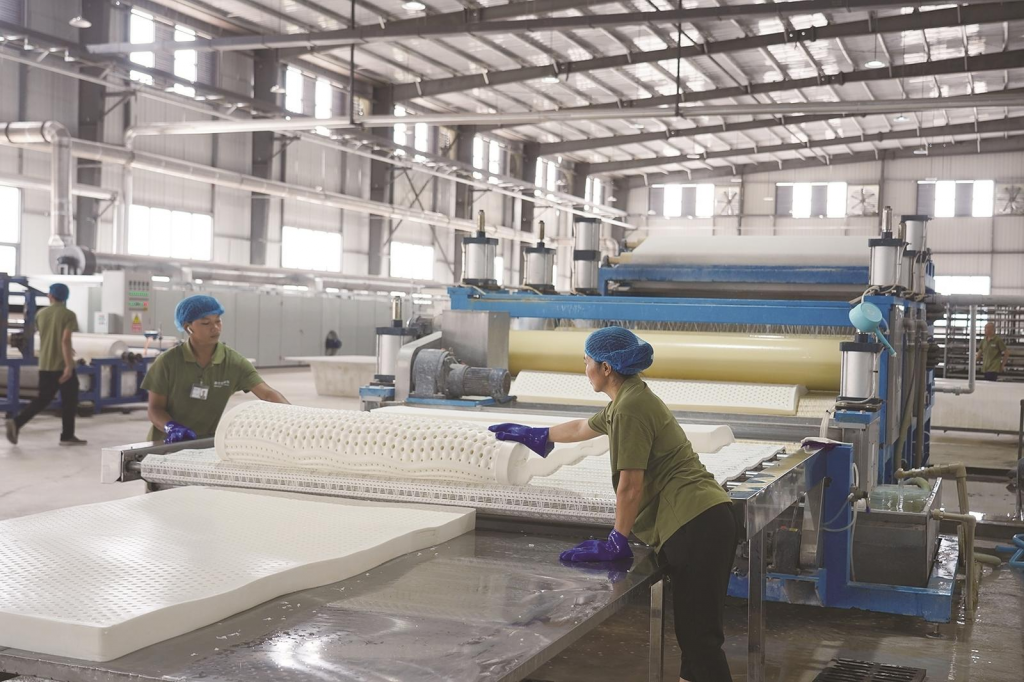
随后进入脱水压片工序:固态橡胶胶体被送入高压挤压设备,通过多次梯度加压,彻底挤出胶体内部多余水分,让松散的胶体逐步压实、塑形,形成薄而坚韧、结构均匀的橡胶片。反复挤压工艺可大幅提升橡胶的密度、韧性与稳定性,是决定成品橡胶耐磨、抗拉伸性能的关键环节。
It then enters the dehydration and tablet-pressing process: the solid rubber colloid is sent into a high-pressure extrusion device, where it undergoes multiple stages of gradient pressure to thoroughly expel excess water inside the colloid, allowing the loose colloid to gradually compact and take shape, forming thin, tough, and uniformly structured rubber sheets. The repeated extrusion process can significantly enhance the density, toughness, and stability of the rubber, and is a key step in determining the wear resistance and tensile performance of the finished rubber.
最后,橡胶片经过专业烘干、精细化修整、分级检测,最终形成标准化天然橡胶成品。依托勐腊成熟的橡胶产业链,这些成品橡胶既可用于生产民用轮胎、鞋底、乳胶制品,也可加工为大型机械专用橡胶辊、国防配套橡胶部件等高端特种产品,广泛应用于民生、工业、国防等多个核心领域。
Finally, the rubber sheets undergo professional drying, fine trimming, and grading inspection, ultimately forming standardized natural rubber products. Relying on Mengla’s mature rubber industry chain, these finished rubber products can be used to produce civilian tires, shoe soles, and latex products, as well as processed into high-end specialized products such as rubber rollers for large machinery and rubber components for national defense. They are widely used in multiple core areas including people’s livelihood, industry, and defense.
四、产业赋能:雨林橡胶的绿色发展新局Industrial Empowerment: The New Prospects of Green Development for Rainforest Rubber
作为云南乃至全国天然橡胶产业的核心标杆区域,勐腊橡胶产业早已突破传统种植采收模式,形成了“种植-采收-加工-销售”的完整闭环产业链。目前全县拥有数十家制胶企业、橡胶木加工企业,同时依托科技赋能,推广橡胶良种定植、胶园绿色管护、水肥一体化智能管理等技术,持续提升橡胶产能与品质。
As a core benchmark region for the natural rubber industry in Yunnan and even across the country, the Mengla rubber industry has long surpassed the traditional cultivation and harvesting model, forming a complete closed-loop industrial chain of ‘planting-harvesting-processing-sales.’ Currently, the county hosts dozens of rubber processing enterprises and rubberwood processing companies. At the same time, leveraging technological empowerment, it promotes the planting of high-quality rubber varieties, green management of rubber plantations, and integrated smart management of water and fertilizer, continuously enhancing rubber production capacity and quality.
从雨林中滴落的一滴天然乳胶,到赋能千行百业的工业原料,勐腊天然橡胶承载着生态价值、民生价值与战略价值。它是边疆群众增收致富的“绿色财富”,是我国天然战略物资自主保障的重要支撑,更是热带特色农业高质量发展的生动缩影。未来,随着科技赋能与产业升级,勐腊橡胶产业将持续深耕绿色、高效、优质发展路径,持续为国民经济发展注入持久动力。
From a drop of natural latex dripping from the rainforest to an industrial raw material empowering countless industries, Mengla natural rubber carries ecological, livelihood, and strategic value. It is the “green wealth” that helps border communities increase their income and prosper, an important support for the independent assurance of China’s natural strategic materials, and a vivid embodiment of high-quality development in tropical characteristic agriculture. In the future, with the empowerment of technology and industrial upgrading, the Mengla rubber industry will continue to deeply cultivate a development path that is green, efficient, and high-quality, continuously injecting lasting momentum into the development of the national economy.
发表回复